Monday, 31 January 2011

Brick Revelation

Last Monday (24th Jan 2011) I was driving home from university on the M62, as I was overtaking a lorry I noticed the web address on it; ‘reclaimedbricks.com’ and for some reason, something twigged in my head which gave me inspiration for my next practical idea.

I started to think about links with using bricks within my work, such as;
Rachel Whiteread's House, 1993 - 1994
Whiteread’s House had the characteristics of a house from the exterior but was much heavier in weight compared to a normal house. It questions the way we think about objects, how we see them and how to see them from a different point of view. 

The demolition of House, 1994
House was demolished on the 11th January 1994 in thirty minutes by order of Bow Council, despite campaigning on Whiteread’s behalf. It now only exists as photographs, drawings and fragments that Whiteread collected from the ruins and memories to all of those who saw it.
‘By the day of demolition, it was covered in graffiti and beginning to look pretty sad; birds were living in it. It took three and a half years to develop, four months to make, and thirty minutes to demolish’ – Rachel Whiteread

It is this concept that gave me some inspiration whilst driving, I began thinking about creating a sculpture which I could create from junk/scrap, photograph it then demolish it, in order to re-build something new from the rubble.

I then thought of artists who use assemblage art, artist’s who I’ve previously researched (see blog post Thursday 20th January 2011 ‘Recent Developments & Research’).

When I got home I began researching into specific pieces by these artists such as;
Andy Goldsworthy’s Bricks and River mud, 1987

Anthony Cragg’s (aka Tony Cragg) Mittelschicht, 1984

Richard Long’s A Line In Japan, 1979

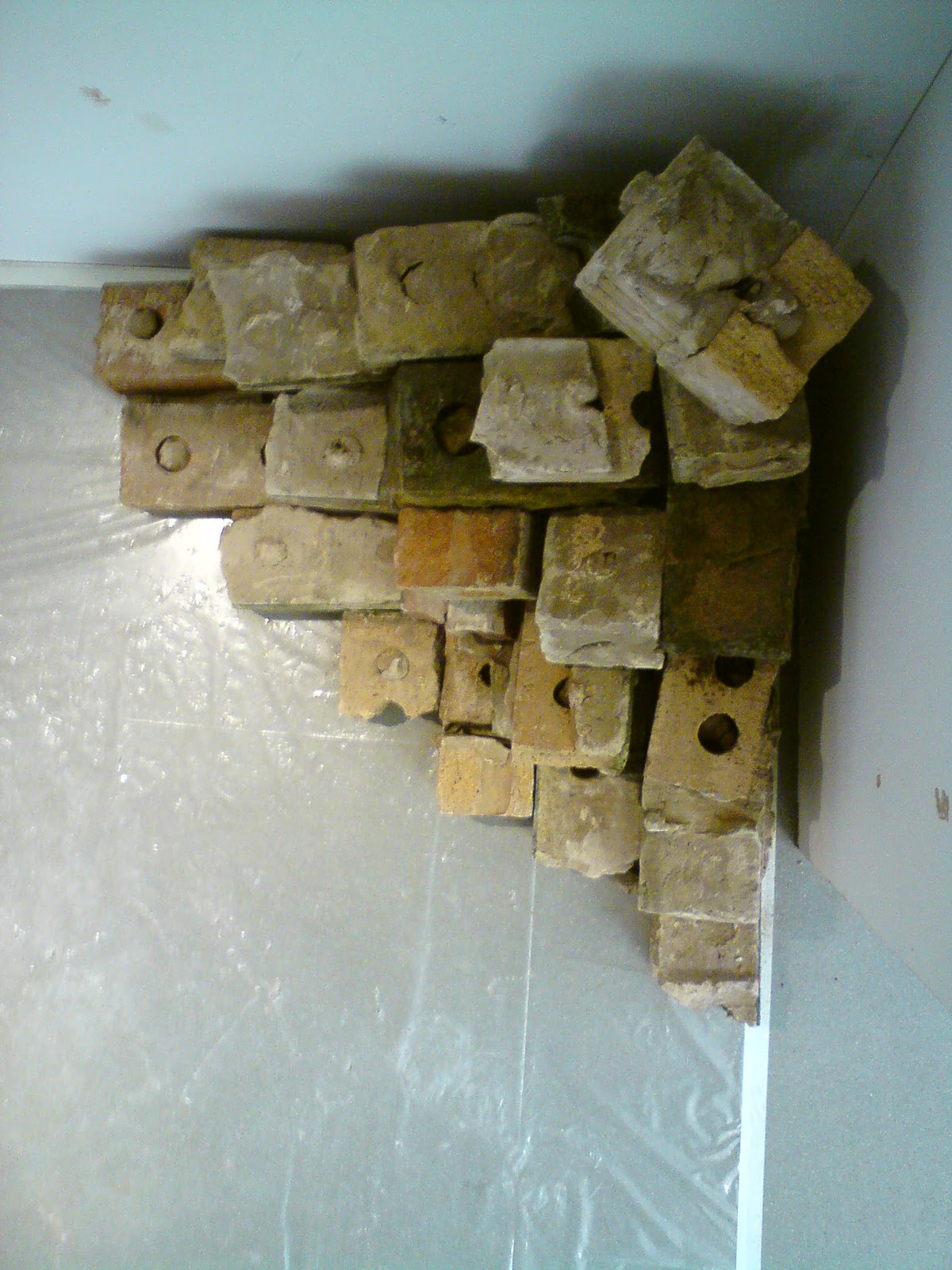
Over the last week Andy & I have been collecting unwanted bricks from various scrap heaps, car parks and through general rubble piles for some sculpture ideas I've had. Today was the beginning of clearing my studio space, laying down some plastic and beginning to build some sculptures using the bricks

I began by creating a brick spiral based on Robert Smithson's Spiral Jetty, I then demolished this sculpture and created a brick sculpture from one of my sketches. Later on in the afternoon I went on to brainstorm other brick sculture ideas for the remainder of this week.


Sunday, 23 January 2011

Evening Inspiration

On Friday evening I was driving to Andy's house (Cronton) and as I looked up over the fields I saw a lovely evening sky line. The clouds had left intriguing trails in the sky, instantly reminding me of my work.

Thursday, 20 January 2011

Recent Developments & Research


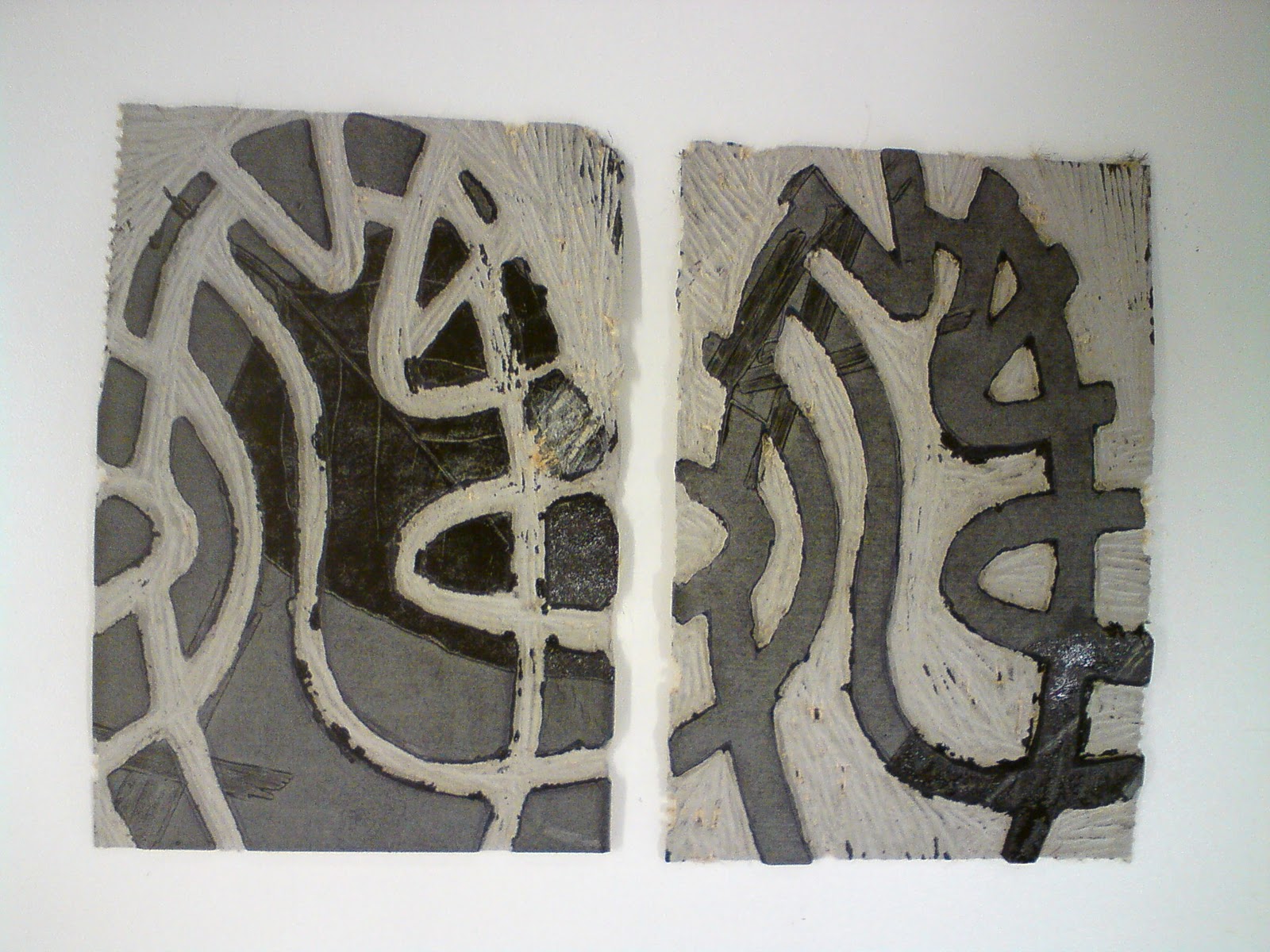
Three months since my last work based post … there have been many developments with my work and much research has been obtained. However, I have decided to continue pursuing my nature/trail based work. I intend to go back into the print rooms within the next two weeks and begin creating trails using various basic techniques including collographs (low level printing), relief printing and mono printing.

I am currently researching as part of my development;
  • Land Art
  • Junk Art
  • Assemblage Art

I’m looking into various artists who use these techniques, such as;
  • Richard Long
  • Robert Smithson
  • John Chamberlain
  • Walter De Maria
  • Andy Goldsworthy

Andy Goldsworthy's Spherical Leafwork, 1988

Goldsworthy’s Spherical Leafwork, 1988 is a sculpture which adopts natural materials, not only as formal elements, but also as tools that hold new shapes together, for example using thorns as a pinning device in this structure. Leaves are a familiar sign of passing time, turning brown and disintegrating with the changing seasons. It is these concepts that Goldsworthy uses that I would like to apply to my work. 

The art of recycling appeals to me as artworks are made from everyday materials and bits of rubbish. Assemblage and Junk Art sometimes evoke a mood of nostalgia, but they also highlight the wastefulness of consumer society and rejected the commercialism of Pop Art.

Land art (also known as Earth art) was developed in the 1970s and drew inspiration both from the natural environment and its raw materials. Land artists work directly onto the landscape itself, sculpting it to make earthworks, or building structures and installations with natural materials, such as branches or rocks.
 
Land art sought to raise awareness of man’s place in both the natural and urban environments. Land art is centred on creating art outside galleries or in public spaces, in the context of the natural world. Goldsworthy’s work is often situated in intimate settings of woodland and seashore, using leaves, twigs and stones. Land artists also occasionally produce their work in galleries, by creating installations made from materials taken from the landscape.

Various examples of Land art include;

Robert Smithson's Spiral Jetty, 1970
Richard Long's Sahara Line, 1988
Walter De Maria's Lightning Field, 1975
David Nash's Threshold Column, 1998
 
Best known for his constructions of crumpled automobile parts, the sculptor and painter John Chamberlain has combined in his work the methods of Junk Art and the aesthetic of Abstract Expressionism.

 
John Chamberlain's Kora, 1963

With his later car sculptures, assembled from scrapyard materials, Chamberlain brought the spontaneity and dynamic colour of Abstract Expressionism to Junk Art.  

I am going to pursuit my nature trails but incorporate this research into my new developments.


Wednesday, 12 January 2011

In the news ...

The success of the window display at the Brindley in October 2010 gained much recognition with the press. LJMU, The Runcorn & Widnes Weekly News visited whilst we were installing the exhibition & Halton council got hold of the story; 

http://www.ljmu.ac.uk/NewsUpdate/index_116481.htm

http://www.runcornandwidnesweeklynews.co.uk/runcorn-widnes-news/runcorn-widnes-local-news/2010/10/21/the-brindley-launches-big-draw-interactive-art-exhibition-55368-27510700/

http://www3.halton.gov.uk/news/newsroom/114575/

More recent success includes a chance for my friend Steph Bennett & myself to exhibit our work in Kirkby library, we're very excited!! So fingers crossed for July - Sept 2011!! I'll keep you posted with any updates!!

Thursday, 14 October 2010

Artistic response to a window display

I was asked by my boss at the Brindley Arts Centre to create the window display for the upcoming exhibition. We usually have vinyl letters on the window for the exhibition, however, for this exhibition I was asked to be creative with the window lettering. The title of the exhibition is ‘The Drawing Show’.

Over the summer I made a lot of wool pom poms for making scarves, and more recently have been using wool in my university work. This inspired me for my idea for the Brindley window.

I began the day by cutting out the letters from cardboard and going outside to see if it was visible enough from outside. When I had cut out the entire title ‘The Drawing Show’ I began to wrap the letters in different coloured wool. When covered I placed on double sided tape & secured to the window, I finished off my idea by creating a web of wool behind the lettering whereby I also attached the wool to the letters on the window. 


Friday, 8 October 2010

Accidentally on purpose? (part 2)

I've just been trying to control my marks with my print making skills, here's some of my creations so far;


This print shows the textures I have used. The relief from the leaves and bark has left quite an impression, some of the bark has stuck itself to the print. Also, some of the dye from the green leaf (bottom left) has come out too.


With this print I was trying to print the tred onto paper with the leaves in the way of some of the lino creating a  silhouette underneath. However, the print didn't turn out too great (to be honest) but the marks left on the lino was very intriguing (I also printed this too, but it wasn't as interesting).

During my lunch break I decided to go on a hunt for natural objects, such as;
    • leaves
    • twigs
    • bark
Then when I returned I decided to work the textures into my print making ideas (as above). When I noticed this piece of bark I thought instead of printing on leaves as I did earlier, what if I was to print directly onto the bark too, and here's the result ... I also threw a leaf on there too, just to see what it would look like...

Accidentally on purpose?


A few days ago I created 2 lino prints based on my motorbike boot tred. I’ve just been down to the print rooms in university to experiment printing them on different surfaces. (Image 1) has a double effect because I didn’t place it on the printing bed far enough, but it makes it stand out from the page slightly, sort of an almost 3D effect. (Image 2) shows the print on the leaf; (Image 3) shows the marks left by the leaf on the lino. (Image 4) shows 2 of the leaves I have printed on, I now intend on creating a few more of these and connecting them together (once they have dried of course!!).

Although, I spoke with my print making tutor Neil, and he thought they could be interesting if they were placed randomly through the studios. He said ‘they are very interesting as they are, I think if they were flat it would ruin the natural effect they have.’

Image 1
Image 2

Image 3

Image 4
 
My final piece (Image 5) was an accident; it was the piece of paper used to stop any paint going on the print making blankets. When I was printing on one of the leaves, some of the paint went past the leaf and printed on the paper. However, I was going to print with my lino but put leaves in the way to get the silhouette of the leaf. I’m going to attempt some more controlled prints this afternoon.
Image 5

Thursday, 7 October 2010

A bit of a coinsidence ... ?

Today I was volunteering at the Brindley Arts Centre, Runcorn, taking down the current exhibition ‘Playful Order: Artist Jeni McConnell’. 

I was cleaning a section of the gallery floor which was covered in coal. This was originally covered with black material to stop the coal going on the floor, but it didn’t work. However, it left fascinating marks on the floor with the coal dust … which I had to hoover up as part of the cleaning job.

While I was cleaning up I started making marks of my own using my footprints to walk through the coal dust and also using the hoover to make marks and patterns.

While I was doing it, it reminded me of a video repetition piece I saw in the Bluecoat Gallery, Liverpool a few months ago. The exhibition was titled ‘Arabicity: Such a Near East’, there was an artist called Raeda Saadeh. She produced a video titled ‘Vacuum’, the video shown her hoovering up the desert.

Wednesday, 6 October 2010

Footprint Making


After being intrigued by the marks my hiking boots made in the mud, I was interested to see what marks would be created with my motorbike boots in the mud. Therefore bringing in the man made / nature element into my work. I think my findings were interesting, especially the one where there were some leaves in the mud where I made the print.

After experimenting using the natural materials available to me outside I thought I would like to experiment using black paint instead to represent engine oil. So I went back to the quarry/fields and experimented with the paint on the natural surface, including:

  • Gravel Paths
  • Grass
  • Tree Trunks
  • Trees
  • Railings
  • Wooden Fences
  • Leaves
  • Sand
  • Sandstone


My next ideas include;

1. Creating a lino print of the tred of the motorbike boot (as the lines appear quite tribal) and incorporating them into current imagery and nature photographs.

2. Bring the outdoors into the studio